Retire Strong with an active, independent life
Build the strength, balance and confidence to take on your next chapter with vigor.
Maybe you’ve been told that getting weaker, stiffer, and less steady is simply part of getting older.
Your body will change. But that doesn’t mean you need to surrender your strength.
You can still learn. You can still adapt. You can still get better.
Susan came to strength training after years as a competitive marathoner, yoga, and ballet enthusiast, when a diagnosis of osteoporosis prompted her doctor to recommend lifting weights. Through postural restoration, corrective exercise, kettlebell strength training, and mobility work, she has improved her bone density from the osteoporosis range to osteopenia, strengthened asymmetries that were holding her back, and improved proprioception affected by neuropathy. She now lifts heavier than ever, including a 150-pound deadlift and 45-pound squats.
What are you training for?
Maybe you want to travel without wondering who will lift your suitcase.
Maybe you want to hike, garden, play pickleball, get down onto the floor, carry your groceries, or pick up your grandchild without holding your breath and hoping for the best.
Maybe you simply want to feel steady when you take the stairs or walk across uneven ground.
These are not small goals.
They are the physical requirements of freedom.
Strength training is not just about how much weight you can lift in a gym. It is about how many options you have outside of it.
Bonnie came to training after years of hip and leg pain had left her nearly unable to walk. Through using Postural Restoration techniques, collaborating with her physical therapy team, and our individualized strength training program, she returned to the active life she had lost—skiing, hiking, and playing pickleball.
You don’t need a watered-down workout.
You need training appropriate to your body, your history, and your goals.
We start where you are. We pay attention to what you feel. We learn which muscles are working, where you compensate, what feels uncertain, and what you need to practice. While you may have been exercising your whole life, you will see a stark difference when you learn to train. Retire Strong students often say, “I had no idea that’s what I was supposed to be doing all this time!”
That’s okay! That’s the point! That’s why you’re here.
The exercises may include weights, resistance bands, balance work, mobility training, getting up and down from the floor, carrying objects, and practicing the movements your actual life demands.
Nothing is random. Nothing is hard simply for the sake of being hard.
But yes—you will work.
We Train For:
-Strength: Build the capacity to lift, carry, push, pull, stand, and move through daily life with greater ease.
Bone health: Use progressively loaded resistance training to support bone strength and long-term physical resilience.
Balance: Improve your ability to control your body, shift your weight, stand on one leg, and respond when the ground—or life—catches you off guard.
Mobility: Develop usable range of motion rather than stretching endlessly and hoping something changes.
Power: Maintain the ability to move quickly when it matters—climbing a step, catching your balance, or getting up from a chair.
Confidence: Learn what your body can do and how to keep progressing safely.
Retire Strong is for you if:
You feel less strong or steady than you used to.
You have been diagnosed with osteopenia or osteoporosis and want appropriate strength training alongside your medical care.
You have completed physical therapy but do not feel ready to exercise independently.
You want to improve balance before a fall forces you to think about it.
You are preparing for more travel, hiking, gardening, sports, or time with family.
You are new to strength training and want someone to actually teach you—not simply count repetitions.
-
If your doctor has cleared you to exercise independently or with a personal trainer, you can train with us.
We’ve worked with clients managing or returning from:
COPD Chronic Obstructive Pulmonary Disease
POTS Postural Orthostatic Tachycardia Syndrome
EDS Ehlers-Danlos syndrome
HMSD Hypermobility Spectrum Disorder
Scoliosis
Osteoporosis and osteopenia
Peripheral neuropathy
ACL and MCL tears
Meniscus tears
Achilles tendon rupture
Frozen shoulder
Rotator cuff tears
Persistent back, hip, knee, and shoulder pain
Joint replacements
Post-surgical rehabilitation
Cancer treatment and survivorship
Returning to exercise after physical therapy
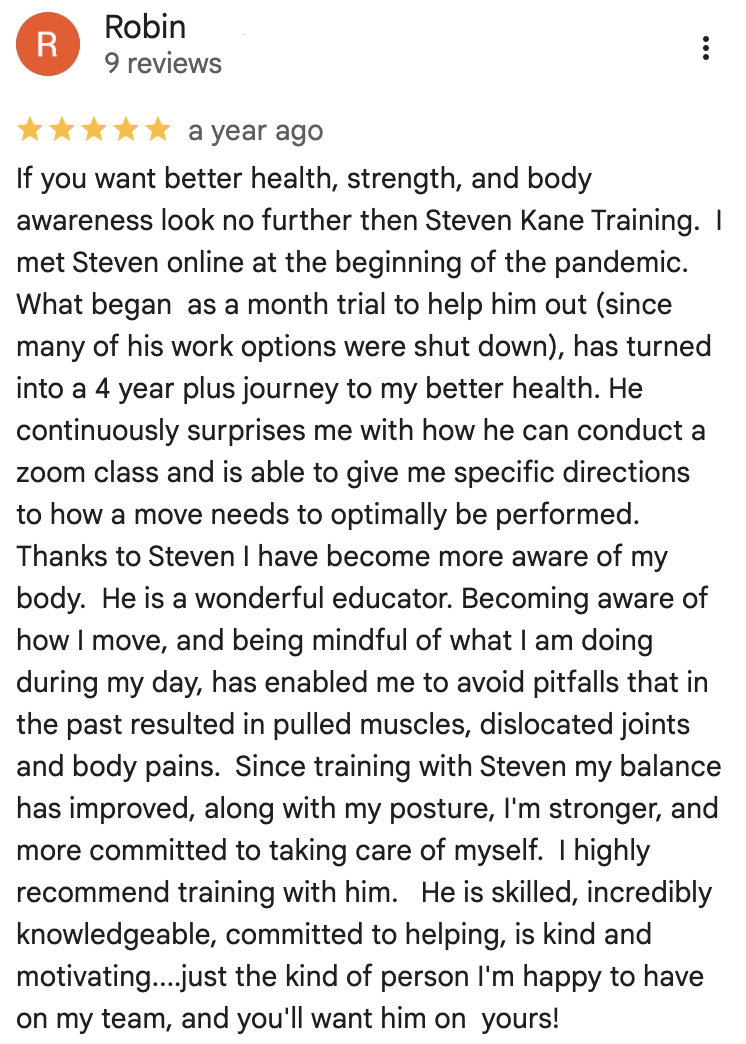
Robin was nice enough to share about her training in this video about a year into training with me.
Years later, she wrote this on Google Reviews:
Your age is part of your training history. It is not the limit of your potential.
You do not need to train like you are 25.
You do need to continue asking your body to learn, adapt, and become stronger.
Retirement should give you more freedom—not fewer physical options.
Let’s train for the life you finally have time to live.